Adrenal Cancer, High Cortisol & Cushing Syndrome: An Important International Study

Adrenal Cancer, High Cortisol & Cushing Syndrome: An Important International Study
If you or someone you love has been told they have adrenocortical carcinoma (ACC) — adrenal cancer — and Cushing syndrome at the same time, you already know this is not a routine “adrenal nodule” conversation. This is a rare, aggressive cancer that can pour out cortisol. That combination is dangerous in two ways at once: the cancer itself, and the storm of high cortisol that weakens the body while the tumor is growing.
A new international study published in The Journal of Clinical Endocrinology & Metabolism (JCEM, 2026) by Dr. Marta Araujo-Castro and colleagues deserves real attention. It is one of the few studies that does not just ask “does this tumor make cortisol?” It asks a harder, more useful question: does the amount of cortisol matter for how the cancer behaves?
The short answer is yes. And that has direct implications for how and where these patients should be treated.
What This Study Actually Looked At
This was a real-world, international retrospective series of 101 patients with adrenocortical carcinoma and overt Cushing syndrome. The cases came from a large multi-center adrenal Cushing syndrome database spanning Spain, Germany, Italy, Croatia, Colombia, and the United States. Diagnoses ranged from 2007 to 2025. Median follow-up was about 19 months.
That matters. ACC with overt Cushing is rare enough that no single hospital sees enough patients to answer these questions well. An international cohort like this is how the field learns.
A few numbers set the stage:
- Median age was about 51 years; roughly three-quarters were women.
- More than half already had metastatic disease at diagnosis (53.5%).
- Median urinary free cortisol (UFC) was 6.4 times the upper limit of normal.
- Nearly 60% met the definition of severe Cushing (UFC more than 5 times the upper limit of normal).
- Median overall survival was only 19.4 months. Disease-free survival after intended curative surgery was 12.3 months. Progression-free survival in metastatic disease was 5.6 months.
These are sobering numbers. They are also a reminder that delay, incomplete surgery, and undertreated cortisol excess are not academic issues. They are survival issues.
The Higher The Cortisol, The More Aggressive The Picture
This is the finding I want every patient and every referring physician to take seriously.
Patients with higher cortisol were more likely to already have metastatic disease. In multivariable analysis, two things independently predicted metastases at diagnosis:
- Larger adrenal tumor size
- Higher UFC (the measured severity of cortisol excess)
Severe Cushing was about 2.5 times more common in metastatic than localized ACC. Hypokalemia (low potassium), a classic marker of very high cortisol, was about 3 times more common in metastatic disease. Both severe Cushing and hypokalemia also became more frequent as stage increased from I to IV.
When the authors looked at recurrence or progression, the pattern was even clearer:
- Mild hypercortisolism (UFC less than 2× normal; “mild” here is within overt Cushing syndrome from adrenal cancer, not the mild adrenal hypercortisolism formerly called MACS): 21% recurrence/progression
- Moderate (2–5× normal): 52%
- Severe (more than 5× normal): 57%
That is not a subtle difference. The intensity of cortisol excess tracked with more aggressive disease.
Overall survival in this particular cohort was driven most strongly by whether the cancer was already metastatic. Cortisol severity did not independently separate overall survival curves the way stage did. That is an important nuance, and the authors are honest about it. But when they combined recurrence (in localized disease) and progression (in metastatic disease), age, UFC, hypokalemia, whether surgery achieved an R0 (complete) resection, and Ki-67 were independent predictors.
In plain language: the amount of cortisol is a marker of tumor aggressiveness, and complete expert surgery still matters.
High Cortisol Has To Be Treated As An Emergency, Not A Side Note
Cushing syndrome from ACC is not the same as a small cortisol-producing adenoma. These patients get infections. They get blood clots. They get profound muscle weakness, diabetes that spirals, and potassium that will not stay up. Mitotane can eventually help control cortisol, but it often takes weeks. Patients with severe excess frequently need steroidogenesis inhibitors such as metyrapone, ketoconazole, osilodrostat, or combinations — now, not after the next tumor board in a month.
This study also described real-world medical control. Combination therapy and mitotane helped many patients, but responses were far from automatic. That is another reason these cases belong in a high-volume adrenal program: endocrinology, adrenal surgery, medical oncology, radiology, pathology, and critical care have to move together.
If you have ACC and high cortisol, waiting to “see how the cancer treatment goes” before addressing the cortisol is the wrong sequence. The cancer and the hormone excess have to be attacked at the same time.
Complete, Expert Surgery Is Not Optional
This is the part of the paper that will surprise no one who operates on these tumors every day — and will surprise many patients who were told “we’ll just biopsy it” or “any surgeon can take it out.”
In localized ACC, adrenalectomy was performed in 43 of 47 patients. Complete biochemical control of Cushing was achieved in 90.7% of those operated patients. An R0 resection — no residual tumor — was achieved in 76.7%. The four patients who did not get complete biochemical remission all had primary tumors 6 cm or larger.
In metastatic disease, the picture was harder, as expected. Thirty-five of 54 patients still underwent adrenalectomy. Complete biochemical response dropped to 40%. R0 was achieved in only about half of those operations. That is not an argument against surgery in selected metastatic patients. It is an argument that the first operation has to be done by someone who understands ACC anatomy, venous invasion, and how not to spill tumor cells.
R0 status remained an independent predictor of recurrence/progression. That is the surgical translation of a simple rule I tell families every week: The first adrenal cancer operation is the one that counts. Incomplete resection, tumor rupture, or a “surprise cancer” encountered by an inexperienced surgeon changes the entire trajectory of the disease.
This is also why I do not believe adrenal cancer should be treated in a low-volume setting. These operations are uncommon. The combination of ACC plus life-threatening Cushing is even less common. Judgment about who needs an open oncologic resection, who can be approached minimally invasively, how to handle the adrenal vein and adjacent organs, and how to get the patient through severe hypercortisolism perioperatively is built on volume.
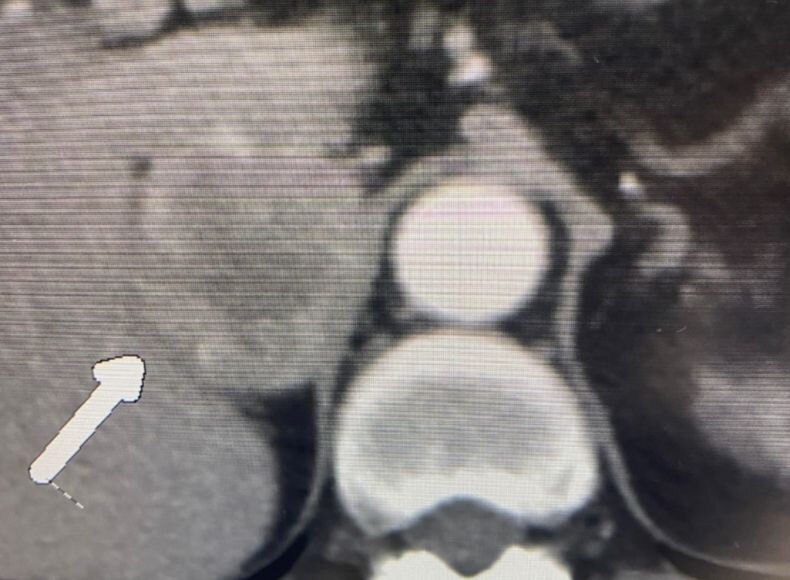
Figure 1: The CT scan showing a right adrenal cancer producing cortisol, which was possible to treat with complete surgical removal.
What This Means At A High-Volume Center
At the Carling Adrenal Center at the Hospital for Endocrine Surgery in Tampa, we built the program around exactly this kind of patient: rare adrenal disease, high hormonal stakes, and surgery that has to be right the first time.
A study like Dr. Araujo-Castro’s is valuable because it gives us a biochemical warning light. A very high UFC and low potassium are not just “Cushing numbers.” In ACC, they are clues that the tumor may already be behaving badly. That information should change speed, not just paperwork. It should trigger:
- Immediate, expert control of cortisol
- Rapid, high-quality staging
- A surgical plan aimed at complete resection whenever feasible
- Honest conversation about Ki-67, margins, mitotane, and clinical trials
- A team that already works together, rather than a collection of consultants meeting the patient for the first time in the ICU
Multidisciplinary care is not a slogan here. An ACC patient with overt Cushing can crash from infection, thrombosis, hyperglycemia, or adrenal crisis after abrupt changes in cortisol. The surgeon who can remove the tumor, the endocrinologist who can titrate inhibitors and replacement, the oncologist who understands mitotane and cytotoxic therapy, and the radiologist who can map tumor thrombus have to be on the same page.
Dr. Tobias Carling, of the Carling Adrenal Center, is one of the world's leading experts in adrenal gland surgery. Dr. Carling has performed thousands of adrenal operations over his career, including more than 2,400 since January 2022 alone. Dr. Carling left Yale University in 2020 to open the Carling Adrenal Center in Tampa, Florida.
To discuss the details of your case with Dr. Carling and become his patient, fill out the new patient form, and he will be in touch with you shortly.
Additional Resources:
- Learn more about the Carling Adrenal Center
- Learn more about Dr. Tobias Carling
- Learn more about our sister surgeons at the Norman Parathyroid Center and Clayman Thyroid Center.
- Learn more about the Hospital for Endocrine Surgery
- Read about high blood pressure, parathyroid disease, and hyperparathyroidism here
- Changes in your blood pressure can also be related to thyroid disease. Read about thyroid disease, hyperthyroidism, and thyroid surgery here