CT Scans, Imaging and Primary Aldosteronism: New Study

CT Scans, Imaging and Primary Aldosteronism: New Study
If you have primary aldosteronism (PA) — also called Conn syndrome — you have almost certainly been shown a CT or MRI and told some version of this sentence: “There is a nodule on the left adrenal, so that must be the problem,” or the opposite: “Both glands look a little bulky, so you are not a surgical candidate.”
A new paper from the University of Michigan in The Journal of Clinical Endocrinology & Metabolism (Mermejo, Turcu, Rainey and colleagues, 2026) is one of the most important recent reminders that those sentences are often wrong.
This is a serious, carefully done study.
What The Michigan Group Actually Did
This was a single study of 173 patients with PA who underwent AVS-guided unilateral adrenalectomy at the University of Michigan between 2012 and 2024. After the gland came out, the team stained it for CYP11B2 (aldosterone synthase), the enzyme that actually makes aldosterone. They then compared that true functional map with a blinded expert re-read of the pre-operative CT or MRI.
That last part is the scientific heart of the paper. They did not ask, “Did the scan match AVS?” They asked a more precise question: Did the scan match the cells that were really making aldosterone?
Using HISTALDO criteria, they found:
- A single aldosterone-producing adenoma (APA, ≥10 mm) in 50.3%
- A single aldosterone-producing nodule (APN, <10 mm) in 22.0%
- Multiple CYP11B2-positive foci in 26.0%
- No CYP11B2-positive lesion in 1.7%
Here’s A Reminder How The HISTALDO Classification Works
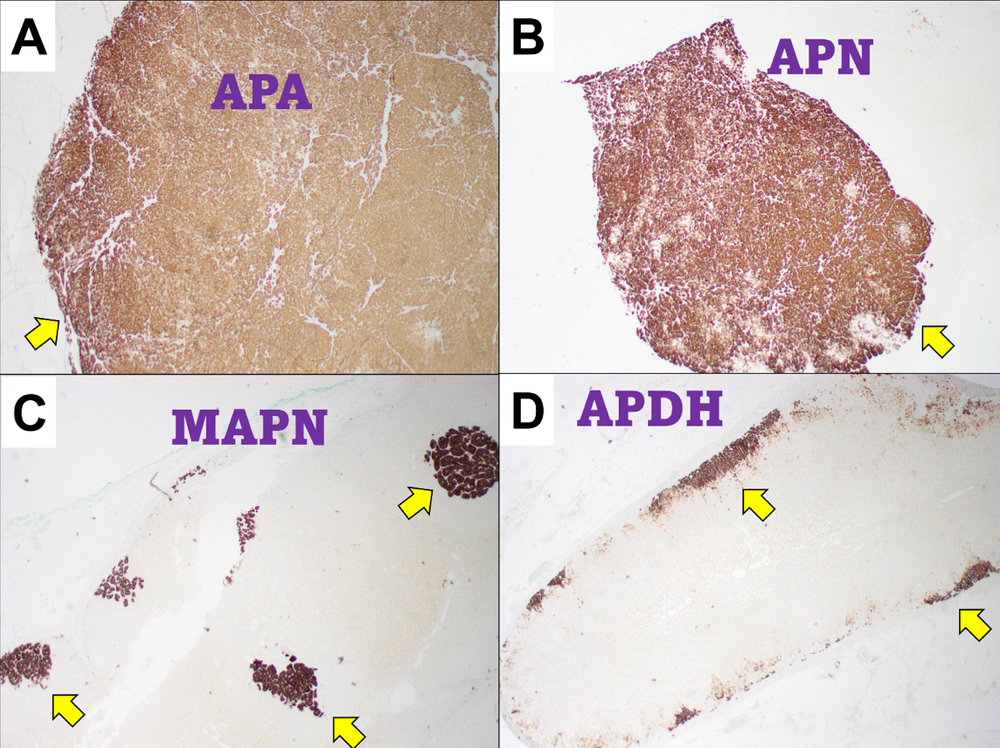
Figure 1. HISTALDO classifications of typical adrenal glands from PA patients showing examples of aldosterone producing adenoma (APA; aldosteronoma, 1 cm or larger), nodule (APN, < 1 cm), multiple aldosterone producing nodules or micronodules (MAPN/M) and diffuse hyperplasia (APDH). Brown color = Aldosterone staining (too much aldosterone production from these cells, yellow arrows)
Now the imaging comparison, which is the part every patient should understand:
- A single corresponding APA or APN on both the scan and the CYP11B2 stain, with an otherwise normal-looking contralateral gland, was present in only 53 of 173 patients — 31%.
- Another 22% had a matching nodule plus adrenal thickening or hyperplasia on imaging.
- 47% had major discrepancies.
Those discrepancies were not trivia. They included extra nodules that were non-functional on stain, bilateral nodules when only one side was the true source, a “normal” or merely hyperplastic-looking gland that still contained discrete aldosterone-producing foci, and glands with a matching visible nodule plus additional hidden CYP11B2-positive areas.
In other words, even in patients already proven by AVS to have lateralized PA, the scan and the real aldosterone source agreed cleanly only about half the time, and agreed in the simple “one nodule, nothing else” way only about a third of the time.
That is why this paper’s conclusion is so blunt: these data caution against targeted therapy guided by cross-sectional imaging alone.
Expert, High-Resolution Adrenal Imaging Is Not A Commodity
I want to be fair to this study and precise about what it shows.
This is a University of Michigan paper, and Michigan is one of the groups that has pushed CYP11B2 science and AVS quality forward. Their radiologist re-read the scans blinded to AVS and to the stain. That is good methodology.
But the scans themselves were a mix of local Michigan studies and outside studies, with various protocols. Slice thickness was generally 5 mm or less. That is typical of “real world” imaging. It is also exactly why so many patients arrive in Tampa with a report that says “normal adrenal glands” or “no adrenal lesions” and a disc that, when we look at it ourselves, is NOT an adrenal-quality study.
At the Carling Adrenal Center, every surgical patient has a dedicated adrenal imaging study performed and reviewed the morning of surgery. I have insisted on this since we opened, because I see a lot of suboptimal imaging. Patients often ask: is one CT scan not equal to another CT scan? No, it’s not. It can be like comparing an old bike to a brand new Ferrari: both are vehicles, but they are not the same thing.
That is not a ceremony. It is because the anatomy you operate on has to match the anatomy you planned on, and because a 3–4 mm aldosterone-producing nodule can be missed, over-called, or confused with a non-functioning incidentaloma or a cortisol-producing tumor if the study is not built for the adrenal glands.
The adrenal radiologists at the Hospital for Endocrine Surgery and I review a very large number of CT and MRI studies specifically of the adrenal glands every year. That volume changes what you see. You learn the difference between a true contour-deforming APN and a limb that merely looks thick on a poor-quality CT scan. You learn when a “bilateral nodule” report is actually one functioning lesion and one incidental non-functioning adenoma or cortisol-producing tumor. You learn when the report says “normal adrenals” and the gland still hides a small subcapsular source.
The Michigan paper is not an argument that imaging is useless. It is an argument that casual imaging is not enough, and that even good imaging is not a stand-alone map of aldosterone production. I agree with both points.
HISTALDO Is Not Optional Pathology. It Is The Diagnosis.
CYP11B2 staining and the HISTALDO classification are how we finally stopped pretending that every yellow nodule on a pathology slide is the source of the aldosterone.
Traditional hematoxylin-and-eosin pathology looks at shape. HISTALDO looks at function. It tells you whether you removed a single classical APA/APN or a gland with multiple aldosterone-producing nodules or micronodules. That distinction predicts the chance of durable biochemical cure and how tightly we should watch the other gland.
The Michigan data fit that framework perfectly. Patients with clean imaging–IHC concordance were more often women and more often harbored KCNJ5 mutations — the molecular signature of the classic, larger, more discrete adenoma. The discordant group was enriched for CACNA1D mutations, which are over-represented in smaller, multifocal, and more “non-classical” disease.
At the Carling Adrenal Center, we use HISTALDO routinely on PA adrenalectomy specimens. The University of Michigan group was among the first in the country to do the same. Many hospitals still do not. If your surgeon cannot tell you whether CYP11B2 staining will be performed on your gland, you are getting yesterday’s pathology on today’s disease.
I will say this as directly as I say it in clinic: you should not have surgery for primary aldosteronism at a center that does not perform HISTALDO / CYP11B2 immunohistochemistry. Without it, nobody can tell you what was actually removed, how likely recurrence is, or whether the opposite gland needs a different long-term plan.
Who Never Made It Into This Study — And Why That Matters
There is a selection issue here that patients need to hear, because it is easy to miss.
Everyone in this paper had both cross-sectional imaging and successful AVS, and then had a total unilateral adrenalectomy. That is a highly filtered group. It is the group that already cleared the two biggest bottlenecks in American PA care: access to technically successful adrenal vein sampling, and a team willing to operate.
We know what happens outside that filter. AVS is expensive, invasive, and unavailable in much of the country. When AVS is required as a rigid gate, many patients who would benefit from surgery never get an operation. They are left on mineralocorticoid-receptor antagonists and a pile of blood-pressure pills, which is inferior to a curative or cytoreductive operation in the right patient.
The paper itself notes that only a minority of people with PA receive appropriate management because the diagnostic pathway is so hard. That is not a criticism of Michigan. It is a criticism of a system that uses a scarce test as the only on-ramp to a better treatment.
Surgery, done well, is superior to a lifetime of pills for lateralized PA. The PASO data in this paper still showed complete biochemical success in 79% overall, and even higher in the fully concordant group. Another important point: partial biochemical success is still better than medical treatment. That is the outcome we should be expanding access to — not rationing.
At the Carling Adrenal Center, Dr. Karan Patel performs AVS all the time, so if you need it you are in good hands. He has a very high success rate when it comes to getting good values from both the right and left adrenal vein.
Total Adrenalectomy Is Not The Only Good Operation
The second selection issue is surgical: every patient had a total unilateral adrenalectomy. Partial adrenalectomy and adrenal-sparing surgery were not part of the toolkit in this series. Few centers in the USA offer this option; the Carling Adrenal Center does.
I understand why the authors then warn against CT-guided partial resection or ablation. Their own data show why shooting at “the nodule on the scan” is dangerous.
That is not an argument against expert adrenal-sparing surgery. It is an argument against imaging-guided targeting without knowing which cells make aldosterone.
At a true high-volume adrenal center, partial (adrenal-sparing) adrenalectomy is a planned operation for selected patients — especially patients with bilateral PA, a prior contralateral adrenalectomy, or a clear dominant lesion whose relationship to the rest of the gland we understand from high-resolution imaging, AVS when needed, and intraoperative judgment. We already know many patients with bilateral disease are left on escalating medical therapy when a carefully chosen partial operation, or a staged adrenal-sparing approach, would lower aldosterone burden without leaving them dependent on lifelong steroid replacement.
What This Paper Should Change Tomorrow Morning
- Stop treating the outside CT report as the diagnosis. In lateralized PA, a clean one-to-one match between the visible nodule and the true aldosterone source happened only one time in three.
- Demand adrenal-quality imaging, read by people who live in these scans. Mixed outside protocols are how nodules are missed, and non-functioning adenomas get blamed.
- Demand HISTALDO. If the hospital cannot stain for aldosterone synthase, it cannot tell you what it removed.
- Do not let lack of AVS become a life sentence on pills if you have a clear surgical phenotype and access to a team that knows when sampling adds value and when it is being used as a barrier. If you need AVS, we’d be happy to set you up with Dr. Karan Patel.
- Ask whether partial, adrenal-sparing surgery is even discussed. If the only offering is total unilateral adrenalectomy, you are being given a narrower menu than the disease requires.
Primary aldosteronism is common, underdiagnosed, and still undertreated. This University of Michigan study is important because it shows, with modern pathology, why a CT or MRI picture is not a functional map. The fix is not to abandon imaging. The fix is better imaging, routine HISTALDO, selective and high-quality AVS, and surgery sophisticated enough to match the real anatomy of the disease.
If you have PA and you have been told “the scan is inconclusive, so we will just adjust your medications,” get another opinion from a center that looks at adrenal glands all day, every day. The nodule on the report may not be the problem. The problem may be that nobody has mapped the aldosterone yet.
Your blood pressure, your potassium, your heart, and your kidneys are worth a complete evaluation — not a guess based on a 5 mm slice.
Dr. Tobias Carling, of the Carling Adrenal Center, is one of the world's leading experts in adrenal gland surgery. Dr. Carling has performed thousands of adrenal operations over his career, including more than 2,400 since January 2022 alone. Dr. Carling left Yale University in 2020 to open the Carling Adrenal Center in Tampa, Florida.
To discuss the details of your case with Dr. Carling and become his patient, fill out the new patient form, and he will be in touch with you shortly.
Additional Resources:
- Learn more about the Carling Adrenal Center
- Learn more about Dr. Tobias Carling
- Learn more about our sister surgeons at the Norman Parathyroid Center and Clayman Thyroid Center.
- Learn more about the Hospital for Endocrine Surgery
- Read about high blood pressure, parathyroid disease, and hyperparathyroidism here
- Changes in your blood pressure can also be related to thyroid disease. Read about thyroid disease, hyperthyroidism, and thyroid surgery here