16 Years! Delay in Diagnosis of Primary Aldosteronism Is Far Too Common

16 Years! Delay in Diagnosis of Primary Aldosteronism Is Far Too Common
Imagine developing high blood pressure at 32. You do everything right: you see your doctor, you take your pills, you add a second pill, then a third. Nobody checks why. Then, at 53, someone finally orders two simple blood tests, aldosterone and renin, and the answer is primary aldosteronism (PA), also called Conn’s syndrome or primary hyperaldosteronism. You have had a hormone problem, often caused by a small benign adrenal tumor, for more than half of your adult life.
That is not a hypothetical patient. That is the typical patient in an important new study published in the Journal of the Endocrine Society.
An Excellent Study From Brazil
Dr. Jessica Montozo, Dr. Livia Mermejo, and their colleagues at the University of São Paulo in Ribeirão Preto reviewed 120 patients with PA treated at their university hospital over 25 years (2000–2025). This is a careful, honest, and very well-done study, and I congratulate the authors. It puts hard numbers on something that every adrenal surgeon sees every week.
Here is what they found:
- A median delay of 16 years from the start of high blood pressure to the diagnosis of PA. One in four patients waited 25 years or more.
- High blood pressure started at a median age of 32; PA was diagnosed at a median age of 53.
- 75% had low potassium by the time they were diagnosed, a sign of advanced disease.
- 98% had moderate or severe PA. Almost half (47.5%) had severe disease, about twice the share seen in a large international study of more than 2,500 patients.
- The delay did not improve in the most recent decade, even though more patients were diagnosed.
The treatment results are just as telling. After adrenalectomy, 78% of patients had the hormone problem completely corrected, and operated patients needed a median of one blood pressure medication instead of three, with better blood pressure than patients treated with pills alone. Only one of the medically treated patients (2%) reached complete blood pressure control. Yet only about one-third of operated patients came off all blood pressure medication. Why? Largely because after 16 years, much of the damage to the blood vessels, heart, and kidneys has already been done.
Exactly What We See At The Carling Adrenal Center
These findings mirror our own experience exactly. Every week we meet patients who clearly have had PA for 16, 20, even 30 years. Many arrive only after a stroke, a heart attack, atrial fibrillation, or kidney damage. When we look back through their records, the clues were there all along: high blood pressure at a young age, blood pressure that needed three or four medications, a low potassium level that was “fixed” with potassium pills, an adrenal nodule seen on a scan years earlier.
And this is a Brazilian study, but please do not think things are any better in the United States. They are not. In the United States, fewer than 2% of patients who should be screened for PA according to guidelines are ever tested. The 2025 Endocrine Society guideline now recommends that everyone with high blood pressure be screened for PA. That is exactly right, and it is long overdue.
What 16 Years Of Too Much Aldosterone Does To The Body
Aldosterone is not just a “blood pressure hormone”. In excess, it directly damages the heart, blood vessels, and kidneys. Compared with people who have ordinary high blood pressure of the same severity, patients with PA have about 2.5 to 4 times the risk of stroke, 2.6 to 6.5 times the risk of heart attack and 3.2 to 12 times the risk of atrial fibrillation, along with a higher risk of heart failure, kidney damage and diabetes. The figure below summarizes it.
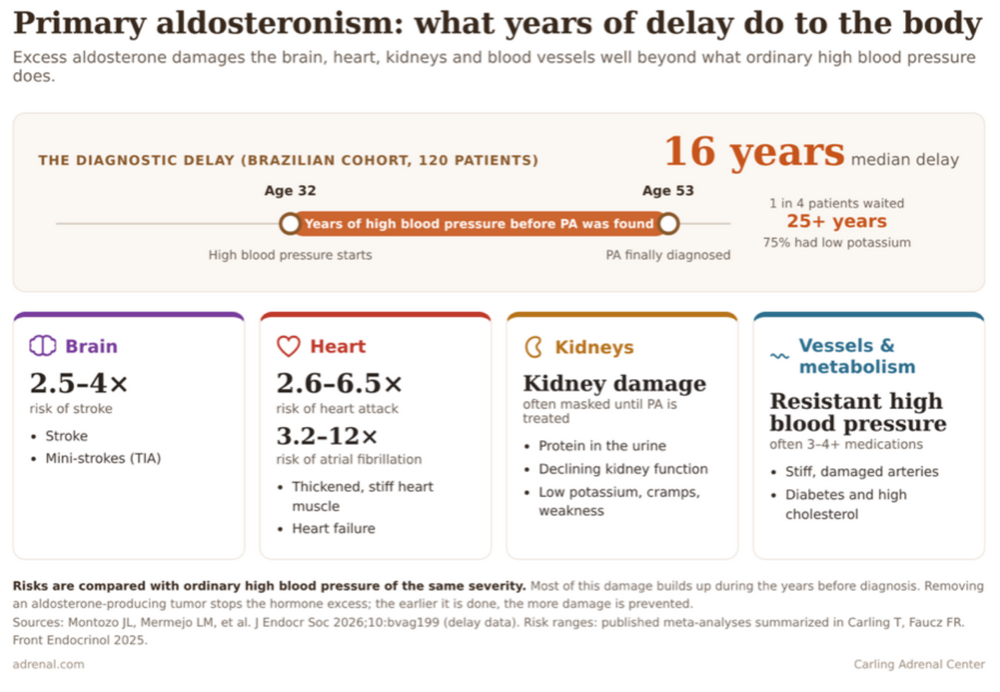
Figure 1. Primary aldosteronism: the diagnostic delay in the Brazilian cohort and the target-organ damage caused by years of aldosterone excess.
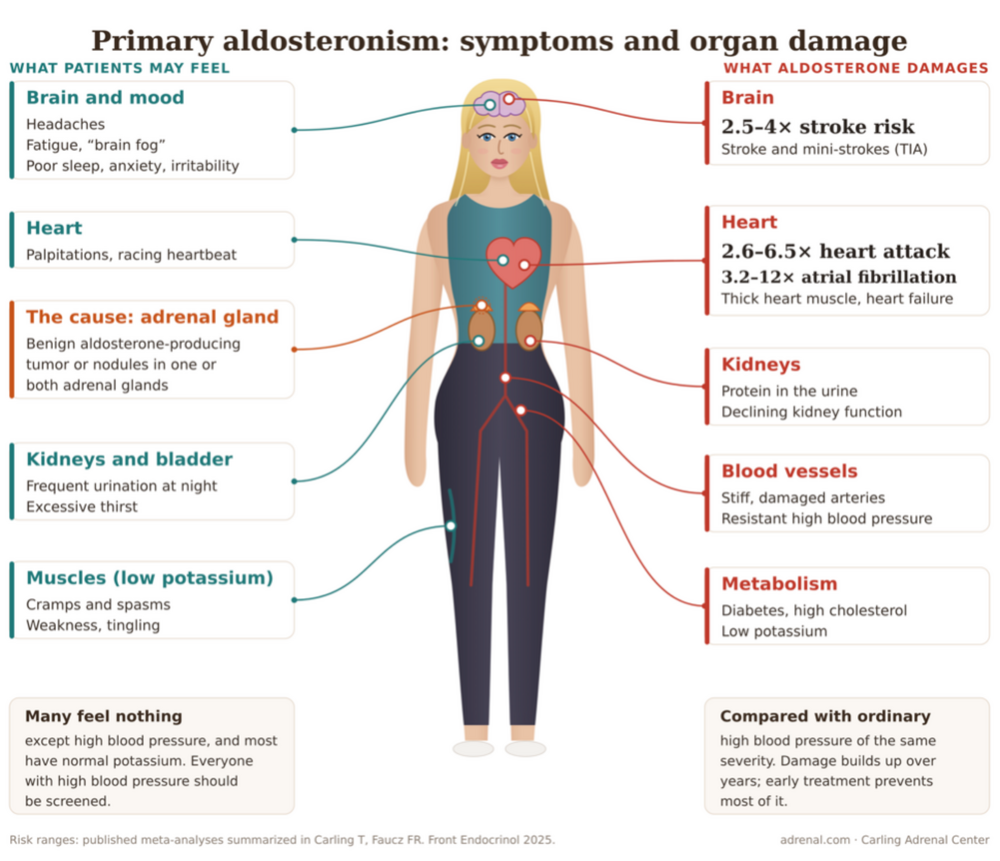
Figure 2. Symptoms of primary aldosteronism and the organs that years of excess aldosterone damage. Many patients have no symptoms other than high blood pressure.
Most Of This Damage Is Preventable
This is what frustrates me most. In the majority of these patients, we believe the strokes, heart attacks, atrial fibrillation, and kidney damage could have been prevented by finding PA early and removing the aldosterone-producing adrenal tumor with a Mini Back Scope Adrenalectomy (MBSA), a very safe operation through the back that typically takes about 20 minutes. Most patients go home the next morning.
The longer PA goes untreated, the less of the damage can be reversed. Blood pressure is most likely to return to normal without medication in younger patients who have had high blood pressure for fewer years. Every year of delay matters.
The study also makes a point that is close to my heart. The authors show that simple severity scores, based on potassium, aldosterone and the number of blood pressure medications, help predict which patients have disease on one side. Adrenal vein sampling (AVS) is invasive and not widely available, and patients should not be left on lifelong pills just because nobody can perform AVS. Read more about who needs adrenal vein sampling and who does not.
What Should You Do?
- If you have high blood pressure, ask to be tested for PA with a blood test for aldosterone and renin. You do not need to have low potassium.
- Be especially insistent if your high blood pressure started before age 40, needs three or more medications, comes with low potassium or atrial fibrillation, or if you have an adrenal nodule on a scan.
- If you have PA, ask whether it can be cured with surgery. Read more about primary aldosteronism and surgery for primary aldosteronism.
Sixteen years is far too long. If you think you may have PA, or you have been told you have it and are not sure what to do next, contact us. We review these cases every day.
Reference
Montozo JL, Elias PCL, Alexandre AE, Molina CAF, Muglia VF, Elias J Jr, Castro M, Moreira AC, Mermejo LM. Delayed diagnosis, greater disease burden: primary aldosteronism in a Brazilian cohort. J Endocr Soc. 2026;10(10):bvag199. doi:10.1210/jendso/bvag199
Dr. Tobias Carling, of the Carling Adrenal Center, is one of the world's leading experts in adrenal gland surgery. Dr. Carling has performed thousands of adrenal operations over his career, including more than 2,400 since January 2022 alone. Dr. Carling left Yale University in 2020 to open the Carling Adrenal Center in Tampa, Florida.
To discuss the details of your case with Dr. Carling and become his patient, fill out the new patient form, and he will be in touch with you shortly.
Additional Resources:
- Learn more about the Carling Adrenal Center
- Learn more about Dr. Tobias Carling
- Learn more about our sister surgeons at the Norman Parathyroid Center and Clayman Thyroid Center.
- Learn more about the Hospital for Endocrine Surgery
- Read about high blood pressure, parathyroid disease, and hyperparathyroidism here
- Changes in your blood pressure can also be related to thyroid disease. Read about thyroid disease, hyperthyroidism, and thyroid surgery here