What is the Best Adrenal Gland Operation for Adrenal Tumors?
Posterior retroperitoneoscopic adrenalectomy is our preferred adrenal operation, used for more than 95% of our operations. Since this can be hard to say, our patients typically call it the Mini Back Scope Adrenalectomy, or simply, MBSA.
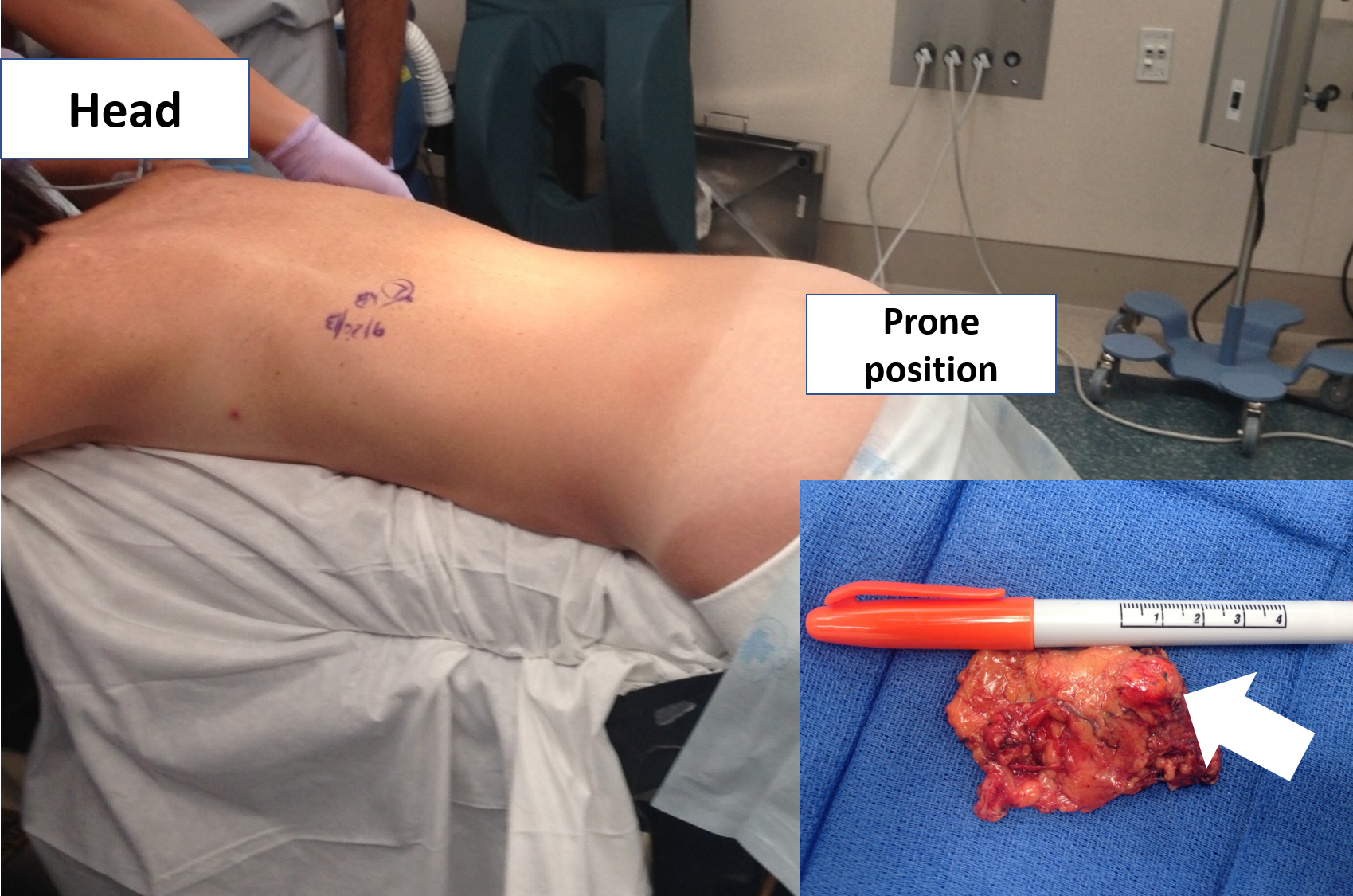 The correct prone position of a patient undergoing a left Mini Back Scope Adrenalectomy (MBSA). This operation was performed by Dr. Carling for a 1.2 cm aldosterone-producing adrenal tumor causing primary aldosteronism (PA; Conn’s syndrome).
There are many reasons we prefer this minimally invasive technique over the other adrenal operations. The operation is performed with a scope (a small high-definition camera) via three small incisions in the lower part of the patient's back. Since the adrenal glands are in the very back part of your abdomen, behind all the other organs, getting to them through the back with a small scope and fine endoscopic instruments makes total sense and has many benefits, but relatively few surgeons perform it. It is rarely taught in general surgery residency because most surgeons in training see too few adrenal operations to learn it.
The correct prone position of a patient undergoing a left Mini Back Scope Adrenalectomy (MBSA). This operation was performed by Dr. Carling for a 1.2 cm aldosterone-producing adrenal tumor causing primary aldosteronism (PA; Conn’s syndrome).
There are many reasons we prefer this minimally invasive technique over the other adrenal operations. The operation is performed with a scope (a small high-definition camera) via three small incisions in the lower part of the patient's back. Since the adrenal glands are in the very back part of your abdomen, behind all the other organs, getting to them through the back with a small scope and fine endoscopic instruments makes total sense and has many benefits, but relatively few surgeons perform it. It is rarely taught in general surgery residency because most surgeons in training see too few adrenal operations to learn it.
Did you know that the typical surgeon who performs adrenal surgery does about one adrenal operation per year, and that more than 80% of adrenalectomies in the United States are performed by low-volume surgeons? Outcomes are better with surgeons who do the operation regularly.
The Advantages of the Mini Back Scope Adrenalectomy (MBSA)
By going through the sides of the back, the surgeon has a very direct approach to the adrenal gland with the Mini Back Scope Adrenalectomy (MBSA). Dr. Carling has used this approach since his time as Chief of Endocrine Surgery at Yale University School of Medicine and has performed it in thousands of patients. Note that this is an advanced technique, and surgeons who operate on adrenal glands only a few times per year are unlikely to offer it. Worldwide, the most commonly performed adrenal operation is laparoscopic adrenalectomy through the front or side of the abdomen, and it can be done well by an experienced surgeon. If that is what you are offered for a small tumor, ask your surgeon how many adrenal operations he or she performs each year and whether a back approach is an option.Like you, we find it cumbersome to say "posterior retroperitoneoscopic adrenalectomy", so we just call it the MBSA, or the "Mini Back Scope Adrenalectomy", since it describes the operation pretty well: a minimally invasive technique using a very small scope and fine instruments that go through the lower back to get the adrenal tumor out. In our experience this is the best adrenal operation for most patients. We have another page that discusses the benefits of the Mini Back Scope Adrenalectomy (MBSA) and why we prefer it to the other adrenal operations.
What is the Safest Adrenal Gland Operation?
The safety of any adrenal operation depends on the skill and experience of the surgeon doing the operation. The Mini Back Scope Adrenalectomy (MBSA), in experienced hands, has very little blood loss, and we believe it is the best adrenal operation for most patients. The robot has not been shown to improve results for adrenal surgery; in our view it adds time and cost without proven benefit (read more about robotic adrenal surgery). The other advantages of the MBSA are that it is faster and avoids the manipulation of the abdominal organs that is required for an operation going through the front of the abdomen. Published comparisons with laparoscopic transabdominal adrenalectomy favor the back approach for operating time, pain and length of hospital stay, with similar complication rates. Less manipulation of the bowel, spleen, stomach, pancreas and other abdominal organs should also mean less risk of injury to the surrounding organs and major vessels.A Mini Back Scope Adrenalectomy (MBSA) typically takes Dr. Carling 20 to 30 minutes. And he performs several per day, not per year.
The limits of the back approach. No operation suits everyone, and the MBSA has limits. The patient lies face down (prone) during the operation, which does not suit every patient. Body build matters: the distance from the skin to the adrenal gland is more important than body mass index (BMI), and when that distance is long the operation is more difficult. The MBSA suits most tumors, but very large tumors or known adrenal cancers may need a different approach, such as open adrenalectomy.
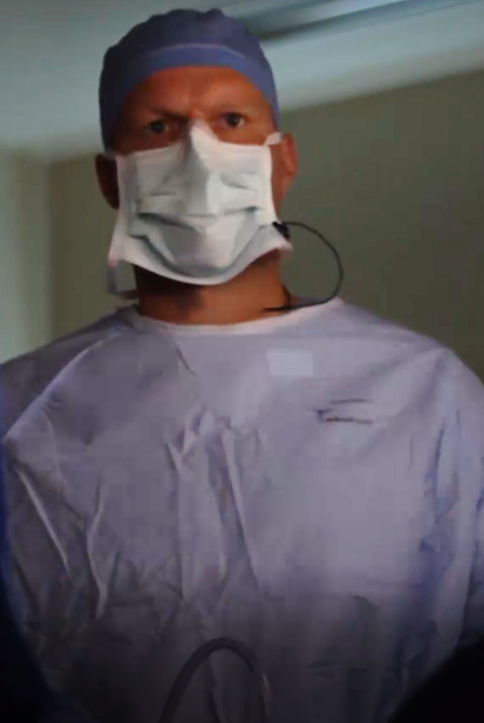 Dr. Carling focuses during a Mini Back Scope Adrenalectomy (MBSA).
Patients who had abdominal surgery in the past and bilateral tumors. The Mini Back Scope Adrenalectomy (MBSA) is particularly helpful in patients who have had previous abdominal operations or have bilateral adrenal tumors. If you have ever had an operation on your abdomen, for instance bariatric surgery (gastric band, sleeve gastrectomy, gastric bypass), gallbladder surgery (cholecystectomy), liver surgery, stomach surgery, bowel surgery of any kind (colectomy, appendectomy, etc.) or a gynecological operation (C-section, hysterectomy, etc.), it is likely you have abdominal scar tissue (called "adhesions"). Another operation through the abdomen means working through that scar tissue, which makes the operation more difficult. With the MBSA, Dr. Carling does not enter the abdomen at all. The whole operation is performed in the retroperitoneal space, where there is no scar tissue from previous abdominal operations, and it does not create new adhesions inside the abdomen. Moreover, with laparoscopic transabdominal adrenalectomy (LTA) the patient lies on his or her side, so when both adrenal glands need surgery the patient has to be turned over between the left and the right side. The MBSA simply allows the surgeon to move from one side of the operating table to the other without moving the patient. Again, it is very important that you have a surgeon who performs adrenal surgery regularly.
Is a fast operation a better operation? How fast the operation is performed is not important in itself; the operation needs to take as long as is required to do it well. But surgeons who have performed an operation hundreds or thousands of times will perform it faster, which usually reflects that things are going well and there are no surprises. Since the MBSA is a quick operation, the patient spends less time under general anesthesia. General anesthesia is very safe, but less time under anesthesia is generally better, especially for older patients.
What are some of the things you should know about adrenal gland surgery? Read more on our adrenal surgery blog
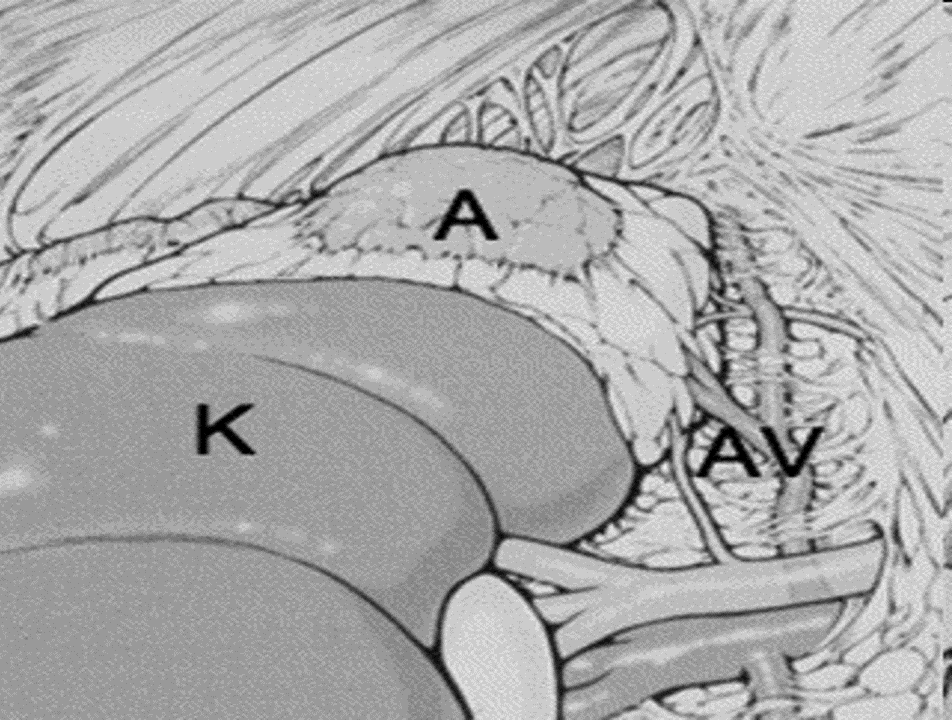 The view of the retroperitoneal space during a left Mini Back Scope Adrenalectomy (MBSA). K = kidney, A = adrenal, AV = left adrenal vein and artery.
As you can see from the figures and the operative videos on this website, as soon as the surgeon enters the retroperitoneum (the space behind the abdominal cavity), he or she has direct access to the adrenal gland. This makes the mobilization of other structures less extensive, which leads to shorter operative times, less blood loss, less postoperative pain and a shorter hospital stay.
The view of the retroperitoneal space during a left Mini Back Scope Adrenalectomy (MBSA). K = kidney, A = adrenal, AV = left adrenal vein and artery.
As you can see from the figures and the operative videos on this website, as soon as the surgeon enters the retroperitoneum (the space behind the abdominal cavity), he or she has direct access to the adrenal gland. This makes the mobilization of other structures less extensive, which leads to shorter operative times, less blood loss, less postoperative pain and a shorter hospital stay.
The scars are small and hidden on the sides of the lower back. The cosmetic outcome after Mini Back Scope Adrenalectomy (MBSA) is excellent. Another advantage of this technique is that it reduces the risk of a postoperative incisional hernia in the abdominal wall. As with any operation, there are small risks; some patients notice temporary numbness or a mild bulge in the flank near the incisions, which usually settles with time.
The Mini Back Scope Adrenalectomy (MBSA): Webinar with Dr. Friedman and Dr. Carling
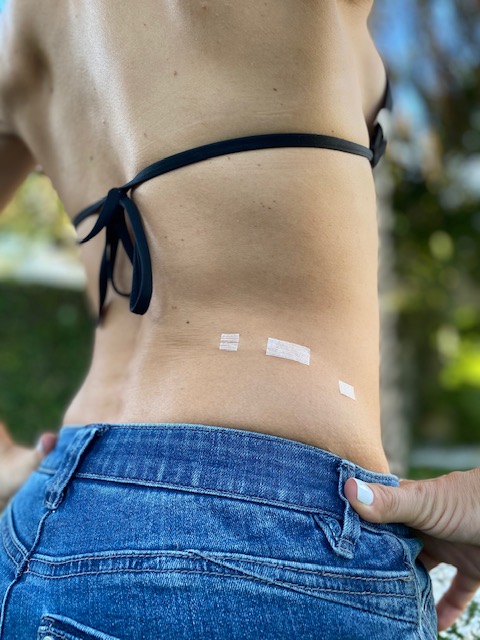 Small Steri-strips (Band-Aids) after Right Mini Back Scope Adrenalectomy; MBSA
If you came this far and you or somebody you know needs an adrenal operation, the next pages for you to read are:
Small Steri-strips (Band-Aids) after Right Mini Back Scope Adrenalectomy; MBSA
If you came this far and you or somebody you know needs an adrenal operation, the next pages for you to read are:
- All the benefits of the Mini Back Scope Adrenalectomy (MBSA) and why we believe it is the best adrenal operation for most people with adrenal tumors.
- How to become our patient and have Dr. Carling perform your adrenal operation.
Last updated October 2026.