What are Adrenal Tumors?
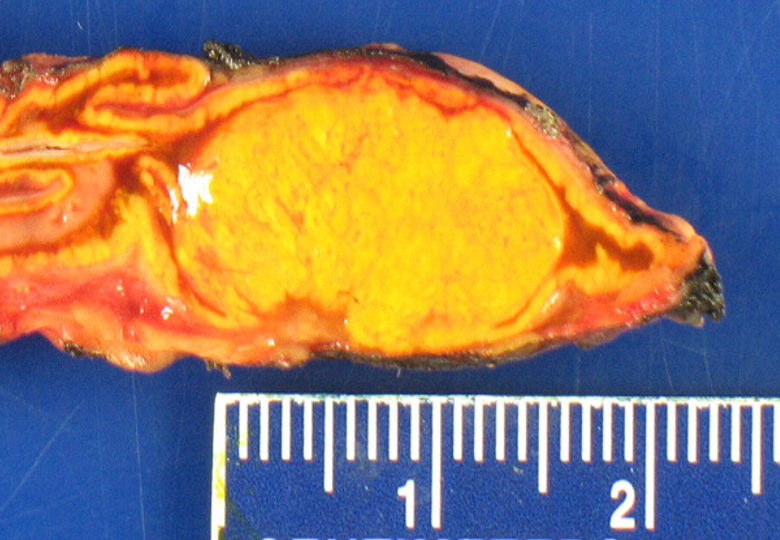 A typical functional adrenal tumor producing excess aldosterone, causing primary aldosteronism (Conn's syndrome).
Tumors are simply abnormal "growths" from an organ, and thus an adrenal tumor is an abnormal growth from an adrenal gland.
A typical functional adrenal tumor producing excess aldosterone, causing primary aldosteronism (Conn's syndrome).
Tumors are simply abnormal "growths" from an organ, and thus an adrenal tumor is an abnormal growth from an adrenal gland.
Adrenal tumors are common. A tumor simply means a mass; your scan report may call it an adrenal adenoma, an adrenal nodule or an adrenal mass. This picture shows a classic adrenal tumor growing within the cortex (outer layer) of the adrenal gland, a triangular gland about the size and shape of a fortune cookie, that we removed during a Mini Back Scope Adrenalectomy (MBSA). Adrenal tumors can be either benign or malignant. The older we get, the more likely we are to develop an adrenal tumor: they are rare in young adults, while about 4–7% of adults have an adrenal tumor, and more with age. The good news is that the large majority are benign (not cancer). Size alone does not decide what should be done: the appearance on the scan, whether the tumor makes hormones, and whether it grows matter more, although tumors over 4 cm deserve particular attention. Read more about the risk of cancer in an adrenal tumor.
Most adrenal tumors are found by accident on a scan done for another reason. These are called adrenal incidentalomas, and every one of them needs hormone testing, even if you feel well.
Do Adrenal Tumors Cause Symptoms and Problems?
Even though the overwhelming majority of adrenal tumors are benign, many of them cause significant and sometimes dramatic symptoms because they produce excess adrenal hormones. Others cause no obvious symptoms while the extra hormone quietly damages the heart, blood vessels, bones and metabolism. A hormone-producing adrenal tumor should almost always be evaluated for surgery, because the excess hormones are toxic to your body, can make you feel miserable and can shorten your life, and removing the tumor is the only treatment that eliminates the source. Too much aldosterone, cortisol or catecholamines (adrenaline-type hormones: epinephrine, norepinephrine and dopamine) harms the body over the long term.Adrenal tumors that make too much hormone are called “functioning” or “endocrine-active” tumors. Cortisol-producing tumors of the adrenal cortex cause adrenal hypercortisolism (AHC), formerly called MACS (mild autonomous cortisol secretion) or subclinical Cushing syndrome; severe AHC is adrenal Cushing syndrome. AHC is the most common hormone excess found in adrenal tumors, and most patients do not look like they have Cushing syndrome. Aldosterone-producing tumors of the adrenal cortex cause primary aldosteronism (PA), also called Conn's syndrome or primary hyperaldosteronism. Tumors of the adrenal medulla that make catecholamines (adrenaline and noradrenaline) are called pheochromocytomas.
There are other less common adrenal tumors such as those that are sex-hormone-producing, adrenocortical cancer (ACC) and metastasis to the adrenal gland. Please use the navigation tools or the search field to locate anything you want to know about the adrenal glands.
Functional Adrenal Tumors are Common and Produce Too Much Hormone, Making You Sick
Adrenal tumors that produce hormones are called "functional" adrenal tumors. That means they function as adrenal tissue is intended to, producing hormones, but they produce too much. It is important to understand that most functional adrenal tumors are not cancer. If your adrenal adenoma produces too much cortisol or aldosterone, it is almost always benign. We operate on patients with functional adrenal tumors almost every working day. The great majority of these tumors are removed via a mini-scope operation (Mini Back Scope Adrenalectomy; MBSA), which typically takes Dr. Carling 20 to 30 minutes to perform. The patient has only a few small Band-Aids on their lower back.
 Typical small Band-Aids at the patient's flank after a Mini Back Scope Adrenalectomy (MBSA) for a functional adrenal tumor causing primary aldosteronism (Conn's syndrome).
Important: an adrenal tumor that overproduces sex-steroid hormones should be considered cancer until proven otherwise, so it is very important to know which hormones are being produced by the adrenal tumor.
Do Functioning Adrenal Tumors Need to be Removed?
Almost always, yes. Not primarily because of the concern for cancer, but because of the damage these "toxic" hormones do to the body. Surgery (adrenalectomy) is the only treatment that removes the source, and we believe it is underused. There are real exceptions: mild or two-sided (bilateral) PA is often treated well with medication, mild AHC is decided individually based on cortisol-related health problems, age, surgical risk and your preference, and tumors in both glands may be best treated with adrenal-sparing (partial) surgery. You can learn more about adrenal surgery on other pages of this website. Dr. Carling performs this operation almost every working day.We are one of the highest-volume adrenal surgery centers in the world, performing up to 750 adrenal operations a year, and we are happy to see you and take care of you if you have an adrenal tumor. Click Here if you want to learn about how to become our patient.
What to read next
- Have your Adrenal Surgery with Dr. Carling. We have an entire page that will walk you through this process. We take almost all insurance types for the operation, but some people will elect to pay for an Online Second Opinion Consultation with Dr. Carling before traveling to Tampa for the operation.
- Mini Back Scope Adrenalectomy (MBSA) Dr. Carling performs up to 750 adrenal operations a year, more than 95% of them as an MBSA. Learn more about this quick operation to remove an adrenal tumor.
- Standard Adrenal Surgery and Other Adrenal Operations. See the other ways adrenal surgery is performed, and why we believe they are not the best choice for most patients.
- How to become our patient
Last updated October 2026.