When Is Open Adrenal Surgery Needed?
Most patients needing adrenal gland surgery can have a minimally invasive operation such as the Mini Back Scope Adrenalectomy (MBSA), and in our practice open surgery through the front of the abdomen is needed in only a small minority of adrenalectomies. In this operation, the surgeon approaches the adrenal glands through a larger incision on the anterior (front) abdominal wall, moving the bowel and other organs out of the way to gain access to the kidney and adrenal glands. Open adrenalectomy is the standard operation for adrenal tumors that are known or suspected to be adrenocortical cancer and for very large tumors, especially if they are invading surrounding structures such as the kidney, liver, spleen, pancreas, bowel or major vessels such as the inferior vena cava (IVC). For adrenal cancer, the goal is to remove the tumor completely, in one piece and with its capsule intact, together with any involved neighboring tissue. An open operation gives the surgeon the best chance of doing that.It is crucial that your adrenal surgeon is comfortable with all techniques of adrenal surgery, including open surgery, since a customized, individual approach will give the best possible outcome. You need an operation that is tailor-made for you and your tumor.
An open transabdominal operation may also be needed in the rare scenario where the patient has a retroperitoneal paraganglioma. Paragangliomas are cousin tumors of pheochromocytomas that arise outside the adrenal gland. In the abdomen they are typically located behind the abdominal cavity (in the retroperitoneum) along the great vessels, meaning the aorta all the way down to the iliac arteries, and occasionally at the urinary bladder. Since these tumors can be intimately involved with the major vessels in your body, open surgery is often required. You can read more about pheochromocytoma and paraganglioma here.
Do Adrenal Tumors Ever Grow Back?
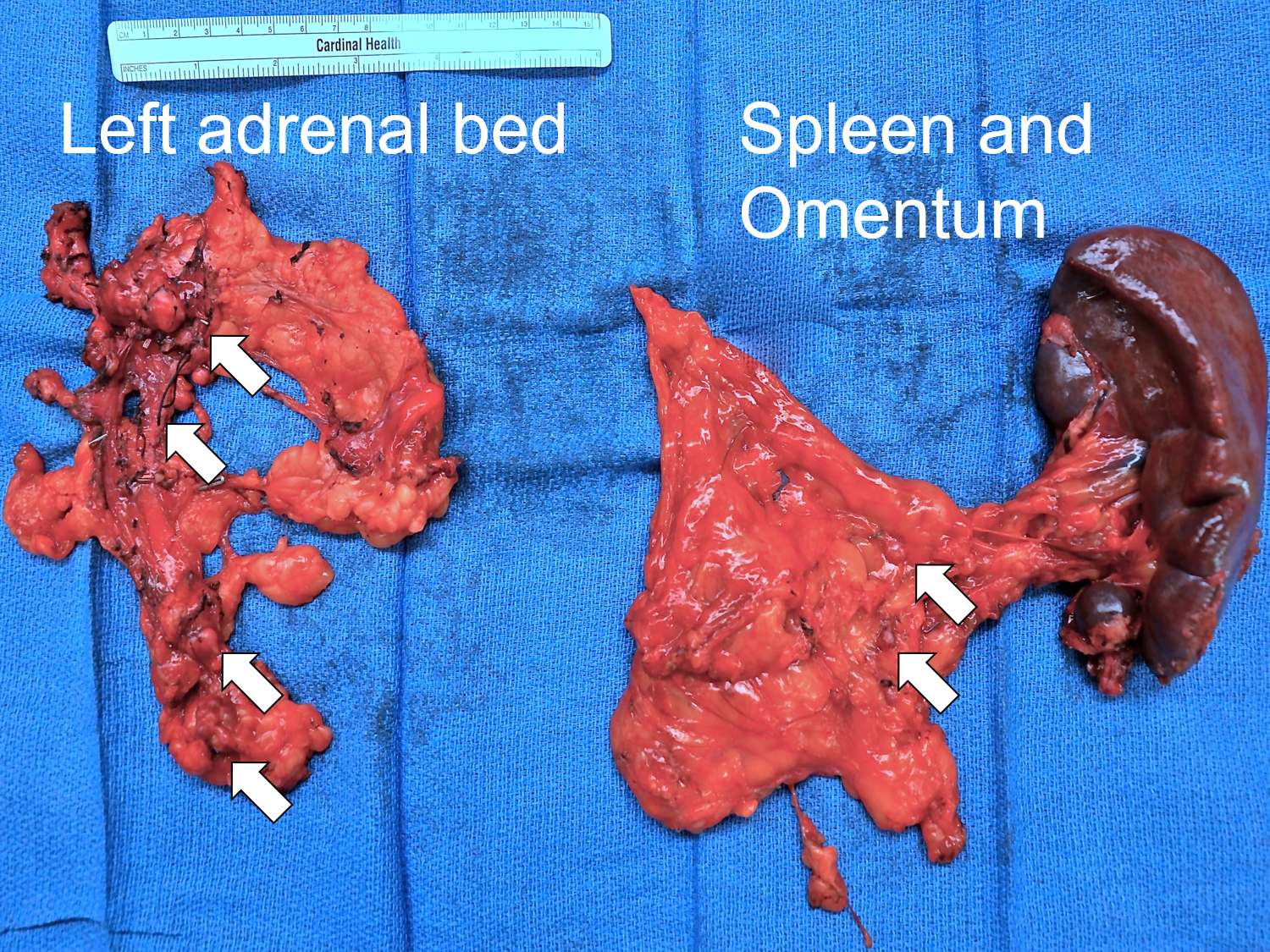 Removed tissue after an open reoperation for pheochromocytoma tumor spilled throughout the abdomen (called “pheochromocytomatosis”) at the initial operation 15 years prior at an outside institution. Dr. Carling achieved a complete resection. The arrows show the tumor implants in the left adrenal bed, the spleen and omentum.
A particularly challenging group of patients we see frequently at the Carling Adrenal Center are those who have a recurrence (re-growth) of their adrenal tumor months or years after a first operation. This most commonly occurs with a pheochromocytoma or adrenocortical carcinoma (adrenal cancer). Sometimes the tumor grows back because it was not completely removed or its capsule was breached during the first operation; sometimes it reflects the biology of the tumor, and adrenal cancer can recur even after a complete resection. The previous operation will also have caused significant scar formation. In this scenario, the best option may be an open operation.
Removed tissue after an open reoperation for pheochromocytoma tumor spilled throughout the abdomen (called “pheochromocytomatosis”) at the initial operation 15 years prior at an outside institution. Dr. Carling achieved a complete resection. The arrows show the tumor implants in the left adrenal bed, the spleen and omentum.
A particularly challenging group of patients we see frequently at the Carling Adrenal Center are those who have a recurrence (re-growth) of their adrenal tumor months or years after a first operation. This most commonly occurs with a pheochromocytoma or adrenocortical carcinoma (adrenal cancer). Sometimes the tumor grows back because it was not completely removed or its capsule was breached during the first operation; sometimes it reflects the biology of the tumor, and adrenal cancer can recur even after a complete resection. The previous operation will also have caused significant scar formation. In this scenario, the best option may be an open operation.
The downsides of the open adrenal operation through the abdomen. The major downsides of an open operation are that the operation takes longer and the recovery takes much longer. Because of the larger incision, the patient may have significant pain (requiring an epidural catheter, strong pain medications, etc.) and typically stays in the hospital 3 to 5 days. For a patient with adrenal cancer, these are worthwhile trade-offs for a complete cancer operation. See our page on the 8 Types of Adrenal Operations to understand more about the pros and cons of each type of adrenal surgery.
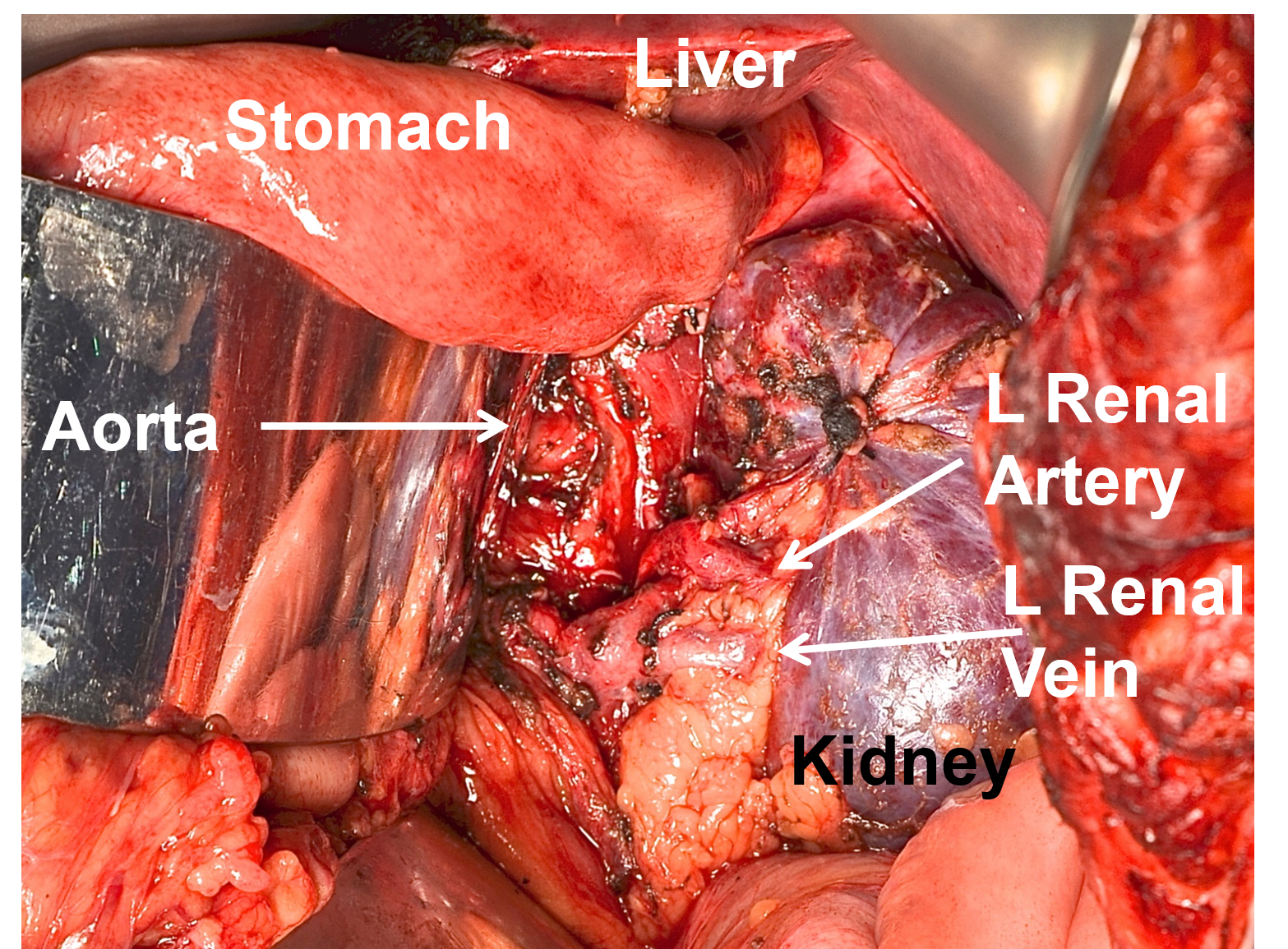 Completed resection after an open reoperation for “pheochromocytomatosis”.
Remember: adrenal surgery can be performed eight different ways. For most patients with small, benign tumors, we believe the best operation is the Mini Back Scope Adrenalectomy (MBSA). Very large tumors and known or suspected adrenal cancers need a different approach, usually open surgery. The technique used depends on the situation at hand, which is why your adrenal surgeon should be comfortable with all of them.
Read more about the Mini Back Scope Adrenalectomy (MBSA) on this page. We use this minimally invasive scope operation for more than 95% of our adrenal operations.
What do patients worry about when it comes to adrenal gland removal? Read more on our adrenal surgery blog
Last updated October 2026.