HISTALDO Classification in Primary Aldosteronism: What Every Patient Needs to Know

HISTALDO Classification in Primary Aldosteronism: What Every Patient Needs to Know
If you have been told you have primary aldosteronism (also called Conn syndrome or PA), you already know this condition is far more than “just high blood pressure.” Excess aldosterone quietly damages your heart, blood vessels, kidneys, and brain while often stealing your energy and quality of life. The good news is that for many patients, expert surgery can be life-changing. But not every case of PA is the same, and the details of your adrenal gland’s pathology matter enormously for predicting how much better you will feel after treatment.
That is why the HISTALDO classification has become such an important advance. At the Carling Adrenal Center, we are one of the few centers in the world that routinely applies this modern histopathology system to every adrenalectomy we perform for primary aldosteronism. It gives us — and you — a clearer, more personalized roadmap than was possible even a few years ago.
What Is HISTALDO and Why Does It Matter?
HISTALDO stands for “Histopathology of Primary Aldosteronism.” It is an international consensus classification that uses special immunohistochemistry staining for the enzyme CYP11B2 (aldosterone synthase) to identify exactly which cells in the adrenal gland are producing the excess hormone.
Traditional pathology looked only at the shape and size of nodules under a regular microscope. HISTALDO adds functional information: it lights up the actual aldosterone-producing cells. This matters because two patients can have what looks like similar “nodules” on imaging or even on standard pathology, yet one may achieve a dramatic, lasting cure after surgery while the other may need ongoing medication and closer monitoring.
HISTALDO divides cases into classical and non-classical histology. This distinction helps us predict how much your blood pressure and potassium issues are likely to improve, whether you are likely to need fewer (or no) blood pressure medications long-term, and how intensively we should follow you afterward. It also helps identify the small subset of patients who may benefit from a partial, function-preserving adrenal operation on the opposite side rather than a full adrenalectomy.
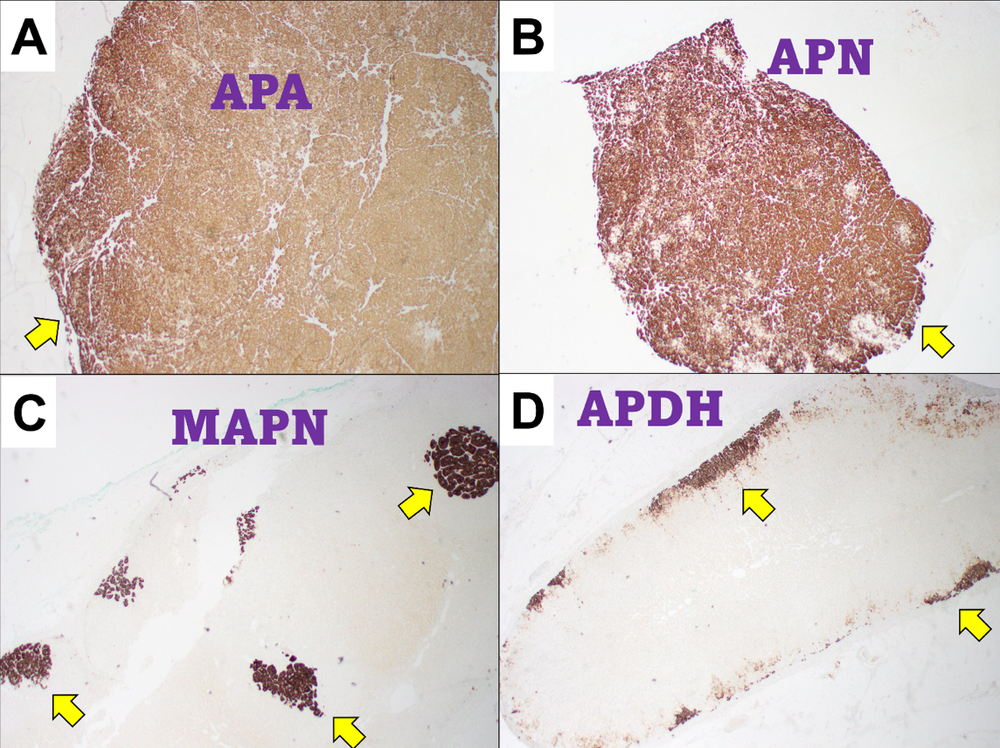
Figure 1: HISTALDO classifications of typical adrenal glands from PA patients showing examples of aldosterone-producing adenoma (APA; aldosteronoma, >1 cm), nodule (APN, < 1 cm), multiple aldosterone-producing nodules (MAPN) and diffuse hyperplasia (APDH). Brown color = Aldosterone staining (too much aldosterone production from these cells, yellow arrows)
Classical Histology: Usually the Best Surgical Candidates
Classical histology typically means there is a single, dominant source of aldosterone overproduction — either an aldosterone-producing adenoma (APA) or an aldosterone-producing nodule (APN). These are the cases that most often behave like the textbook “Conn adenoma; aldosteronoma”
After we remove the affected adrenal gland with our minimally invasive posterior retroperitoneoscopic (Mini Back Scope) technique, the majority of these patients experience:
- Substantial drops in blood pressure, often allowing them to stop or dramatically reduce blood pressure medications
- Normalization of potassium without supplements
- Very low risk of biochemical recurrence (usually under 5%)
- Excellent long-term cardiovascular and kidney protection
In these patients, the HISTALDO classification gives us high confidence that we have removed the primary driver of the disease. The improvement in blood pressure can often be predicted quite accurately based on the combination of pre-operative factors (age, duration of hypertension, number of medications, kidney function) and the classical histology on the final pathology.
Non-Classical Histology: More Complex but Still Very Treatable
Non-classical histology includes multiple aldosterone-producing nodules (MAPN) or aldosterone-producing diffuse hyperplasia (APDH). Here, the overproduction is more widespread across the adrenal gland rather than coming from one dominant lesion.
These patients can still benefit enormously from surgery, especially when adrenal vein sampling has clearly shown that one side is producing far more aldosterone than the other. However, the outcomes are more variable. Blood pressure usually improves, but patients may need to continue some medication and require closer long-term monitoring because there is a higher chance that the opposite adrenal gland could become more active over time or that small areas of overproduction remain.
The key point I want every patient to understand is this: non-classical histology does not mean surgery was the wrong choice. It simply means we tailor your follow-up plan more carefully and set realistic expectations together from the beginning.
Predicting Your Blood Pressure Improvement
One of the most powerful aspects of HISTALDO is how it improves our ability to counsel patients about expected blood pressure outcomes. When we combine your clinical picture (how long you have had hypertension, how many medications you take, your age and kidney function) with the final HISTALDO classification, we can give you a much more individualized prediction of how much better your blood pressure is likely to become.
Patients with classical histology and favorable pre-operative factors often see the most dramatic improvements — many become normotensive off most or all medications. Patients with non-classical histology still improve significantly in the majority of cases, but the degree of improvement and the likelihood of becoming completely medication-free tend to be more modest. Having this information upfront helps you and your family plan ahead.
A Small but Important Group: Partial, Bilateral Function-Preserving Surgery
HISTALDO also helps us identify the small percentage of patients (generally less than 3–5%) who may be candidates for a partial adrenalectomy on the opposite side rather than just treating with ever-increasing blood pressure pills and medications. In carefully selected cases, we can preserve adrenal function while still controlling the disease. This is an advanced option that requires true high-volume expertise in both surgery and interpretation of sophisticated pathology like HISTALDO.
Why Choose a Center That Uses HISTALDO Routinely?
Most hospitals and even many adrenal surgery programs do not routinely perform CYP11B2 staining or apply the full HISTALDO classification. At the Carling Adrenal Center, we do this for every patient because it directly improves decision-making and counseling. When you come to us, you are not just getting an operation — you are getting a complete diagnostic and prognostic picture that guides your care for years to come.
Our high surgical volume (>700 adrenal cases per year) also means we see the full spectrum of classical and non-classical disease. We have learned which patients do best with surgery, which ones benefit from partial approaches, and how to optimize long-term medical therapy when needed. This experience translates into better outcomes and more honest, personalized conversations before surgery.
What Patients Need to Know
Here are the key takeaways I share with patients every week:
- Primary aldosteronism is common, underdiagnosed, and highly treatable — especially when you see an expert team.
- HISTALDO gives us a functional map of your adrenal gland that standard pathology cannot provide.
- Classical histology generally predicts the best chance of major blood pressure improvement and low recurrence risk.
- Non-classical histology is still very treatable with surgery but usually requires a more customized long-term plan.
- We can often predict how much your blood pressure will improve by combining your clinical history and follow-up labs with the HISTALDO result.
- A very small subset of patients may benefit from partial, function-preserving surgery on the opposite side — an option that requires sophisticated pathology and surgical expertise.
- Choosing a high-volume center that uses advanced tools like HISTALDO routinely gives you the clearest answers and the best chance of an excellent outcome.
Moving Forward with Confidence
If you have primary aldosteronism, you deserve more than a generic “you have high blood pressure — take these pills” approach. You deserve a precise diagnosis, an honest discussion of what surgery can realistically achieve for you, and a team that will stand with you for the long term.
At the Carling Adrenal Center, we are committed to giving every patient the benefit of the most advanced tools available — including routine HISTALDO classification — combined with the experience that comes from performing the highest volumes of adrenal surgery in the world.
If you or your doctor suspect primary aldosteronism, or if you have already been diagnosed and want a second opinion from a team that uses these modern methods every day, I invite you to reach out.
Your blood pressure, your heart, your kidneys, and your quality of life are worth getting right.
Dr. Tobias Carling, of the Carling Adrenal Center, is one of the world's leading experts in adrenal gland surgery. Dr. Carling performs more adrenal operations than any other surgeon in America. Dr. Carling left Yale University in 2020 to open the Carling Adrenal Center in Tampa, Florida.
To discuss the details of your case with Dr. Carling and become his patient, fill out the new patient form, and he will be in touch with you shortly.
Additional Resources:
- Learn more about the Carling Adrenal Center
- Learn more about Dr. Tobias Carling
- Learn more about our sister surgeons at the Norman Parathyroid Center and Clayman Thyroid Center.
- Learn more about the Hospital for Endocrine Surgery
- Read about high blood pressure, parathyroid disease, and hyperparathyroidism here
- Changes in your blood pressure can also be related to thyroid disease. Read about thyroid disease, hyperthyroidism, and thyroid surgery here