Primary Aldosteronism: Adrenalectomy Could Save More Lives

High Blood Pressure, Aldosterone, and an Adrenal Tumor
If you have high blood pressure that just won't budge, could an adrenal surgery be the cure you've been missing? As the Founder and Director of the Carling Adrenal Center, the world's highest-volume adrenal surgery center, I have operated on more than a thousand of patients with primary aldosteronism (PA), and I see lives transformed every day. But I've also witnessed the tragedy of underdiagnosis and undertreatment. In a recent scientific article I co-authored with Dr. Fabio Faucz and published in Frontiers in Endocrinology, we lay out the stark reality: PA is a silent killer, driving preventable heart attacks, strokes, and deaths, and expert adrenal surgery is the game-changer that's being overlooked. Let me break it down for you, step by step, because if you're one of the 4.5–20% of hypertensives with PA, this could be lifesaving.
Picture this: A 52-year-old man comes to the Carling Adrenal Center from across the country, frustrated after years of escalating blood pressure meds. He's tired, dealing with muscle cramps, headaches, and a nagging fear of stroke, symptoms he'd chalked up to "just getting older." A quick aldosterone-to-renin ratio (ARR) test reveals PA, caused by a small adenoma on one adrenal gland overproducing aldosterone. We perform a Mini Back Scope Adrenalectomy (MBSA), a precise, minimally invasive procedure done in under 20 minutes, and he's cured. Off meds, back to normal life. This isn't rare; it's what happens every day at our center. But millions aren't so lucky because PA remains profoundly underdiagnosed.
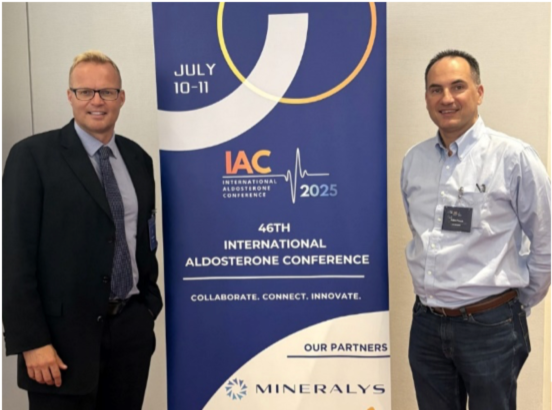
Figure 1: Dr. Carling and Dr. Faucz published an important scientific, peer-reviewed article in the world-renowned journal Frontiers in Endocrinology. This blog post summarizes their findings in an easy-to-understand popular science article. Dr. Carling and Faucz earlier in 2025 at the 46th International Aldosterone Conference (IAC) in San Francisco, where Dr. Carling gave a lecture about adrenal surgery for primary aldosteronism (PA)
What You Need to Know: Primary Aldosteronism as a Driver of Morbidity and Mortality
Primary aldosteronism isn't just high blood pressure—it's secondary hypertension with a specific, treatable cause. Your adrenal glands, those small organs atop your kidneys, go haywire, pumping out excess aldosterone. This hormone disrupts the balance of salt and water, spiking blood pressure and causing widespread damage. Affecting up to 12,100 people per million, PA hits working-age adults hard, increasing mortality by 10–20% over 5–10 years compared to essential hypertension. Why? Aldosterone doesn't stop at BP elevation; it promotes heart fibrosis, left ventricular hypertrophy, endothelial dysfunction, kidney damage, and more, leading to a 2.5–4-fold higher stroke risk, a 2.6–6.5-fold increase in heart attacks, and a 3.2–12-fold jump in atrial fibrillation.
And that's not all. In up to 30% of cases, there's co-secretion of cortisol, compounding issues with obesity, diabetes, and osteoporosis. It's a hormonal assault on your body. Frequently misdiagnosed as essential hypertension, PA escapes detection, fueling a hidden epidemic. Without expert intervention, patients face chronic morbidity, lost productivity, and skyrocketing healthcare costs. But here's the good news: This is reversible with the right approach.
The Power of Adrenal Surgery in PA: Why It Beats Medications Every Time
If your PA is on just one side, often caused by a small tumor with specific genetic changes, adrenal surgery isn't just an option; it's a game-changer. Our research shows it dramatically lowers the chance of dying from heart-related issues, far better than relying on pills alone. In simple terms, surgery reduces that risk by about 8% over six years. And here's what that means in real life: We only need to operate on around 13 patients to prevent one unnecessary death. That's powerful stuff.
Now, let's put this in perspective by comparing it to some well-known heart and vascular surgeries. These are major procedures, but adrenal surgery holds its own, and often comes out ahead, especially since PA patients are usually in their early 50s, giving them many more healthy years ahead:
- Replacing a faulty heart valve (TAVR) in severe cases: This saves lives in high-risk older individuals (around 80), but transcatheter aortic valve replacement (TAVR) offers similar benefits for much younger patients.
- Fixing a bulging abdominal aorta (AAA repair): It prevents deadly ruptures, but again, typically for people in their 70s, adrenal surgery matches or beats it in impact.
- Bypass surgery for blocked heart arteries (CABG): Great for certain heart conditions, but adrenal surgery edges it out in reducing risks, with patients gaining decades more.
- Clearing blocked neck arteries (CEA) to prevent strokes: This helps, but adrenal surgery provides stronger protection against death and complications.
A large nationwide Swedish study backed this up: Among thousands of PA patients tracked for over eight years, those who had surgery saw their overall death risk drop to match people without PA at all. Medications like spironolactone can help control symptoms, but they don't reverse the damage as effectively, and they come with side effects that surgery avoids.
Even for PA, affecting both adrenal glands, we're making strides with targeted, partial surgery that preserves healthy tissue. This approach cures the hormone imbalance in most cases without needing lifelong replacement medications with hydrocortisones, and the risks are extremely low in experienced hands.
At the end of the day, if you're battling tough-to-control high blood pressure, surgery could restore your health in ways pills simply can't. It's why I urge patients to get evaluated by experts who do this every day.
Global Potential for Surgery in PA: The Shocking Disparities
We looked at data from health registries and studies in countries like Sweden, Taiwan, France, the UK, Germany, and the USA. The current rates of adrenal surgery for PA? Abysmal! They are way too low across the board. Sweden stands out as the leader, performing far more of these surgeries per person, thanks to their healthcare and strong systems for tracking cases. Taiwan and Germany aren't far behind, boosted by active research groups and clear medical guidelines.
But in France, the UK, and the USA, the numbers are dismal, barely a tiny fraction of what's needed. In an ideal world, we'd be doing many more surgeries, since roughly a third of PA cases involve just one side and can be cured surgically. For the USA, this gap means missing out on tens of thousands of life-saving procedures every year, leading to thousands of preventable deaths from heart issues and strokes.
To fix this, we'd have to dramatically boost our ability to perform these surgeries—dozens or even hundreds of times more than now. The reasons for these differences? Countries like Sweden, Taiwan, and Germany shine because of their focus on research, practical guidelines, and easy access to expert centers. In the USA, UK, and France, too few patients get screened or referred to specialists, leaving many to struggle without the help they need.
At the Carling Adrenal Center, I handle more PA surgeries in a single year than some whole countries (looking at you, France, with only 83 cases per year) do, which shows that quick expansion is possible with the right dedication and setup. Simply put, we need numerous Carling Adrenal Centers all over the globe!
Diagnostic Challenges: Why PA Hides in Plain Sight
The aldosterone-to-renin ratio (ARR) screening, essential for detection, is used in <2–5% of hypertensives, despite guidelines. The 2025 Endocrine Society update calls for universal screening in all with high BP, a major shift. Confirmatory tests and adrenal vein sampling (AVS) are complex, with AVS failing 10–92% depending on expertise.
What every hypertensive patient needs to know: If you have resistant BP, hypokalemia, early-onset hypertension, atrial fibrillation, sleep apnea, or family CV history, get screened. Stratify by severity: Severe cases can skip AVS and go straight to surgery if imaging is clear.
Discussion and Path Forward: Time to Act on This Silent Epidemic
Tackling PA requires an overhaul: Routine ARR in primary care, expanded high-volume centers, and awareness campaigns. Emerging tools like AI for data analysis and aldosterone synthase inhibitors (e.g., baxdrostat) may help mild cases, but for unilateral PA, surgery is curative.
In conclusion, the underuse of adrenalectomy for PA is claiming lives unnecessarily. By following models from Sweden, Taiwan, and Germany, integrating registries, research, and specialized care, we can close gaps and save thousands. If you're dealing with uncontrolled hypertension, don't wait. Contact the Carling Adrenal Center today for expert evaluation. As the highest-volume adrenal surgeon worldwide, I assure you: This is, without a doubt, the path to better health and a longer life.
Reference:
- Carling Tobias, Faucz Fabio R. Primary aldosteronism: adrenalectomy could save more lives. Frontiers in Endocrinology. Volume 16 – 2025
- www.frontiersin.org/journals/endocrinology/articles/10.3389/fendo.2025.1737160
- https://doi.org/10.3389/fendo.2025.1737160
Dr. Tobias Carling, of the Carling Adrenal Center, is one of the world's leading experts in adrenal gland surgery. Dr. Carling performs more adrenal operations than any other surgeon in America. Dr. Carling left Yale University in 2020 to open the Carling Adrenal Center in Tampa, Florida.
To discuss the details of your case with Dr. Carling and become his patient, fill out the new patient form and he will be in touch with you shortly.
Additional Resources:
- Learn more about the Carling Adrenal Center
- Learn more about Dr. Tobias Carling
- Learn more about our sister surgeons at the Norman Parathyroid Center, and Clayman Thyroid Center.
- Learn more about the Hospital for Endocrine Surgery